Transport Fever 3 · Community questions answered
Two trains block each other? Inspect the rear of the waiting train
On this page
Check whether a train stopped beyond the junction still leaves its rear across the other train’s route. The waiting position needs room for the complete train to clear the switch. Another signal in the same cramped space can preserve the blockage.
Published October 20, 2026 · Mouse and keyboard · Sources checked October 19
Distinguish a queue from a circular wait
Players asking why two trains will not pass often expect an unused parallel track to solve the problem automatically. First identify what each train is waiting for. If A needs space occupied by B, while B cannot leave until A moves, you have a different problem from a train simply following a moving service.
Pause for inspection and select both trains in turn. Record their next stops, intended paths and the position of each rear wagon. The front locomotive may already be beyond the crossing while its consist still obstructs it.
Compare the blocked and cleared positions
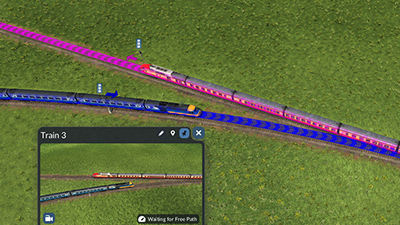
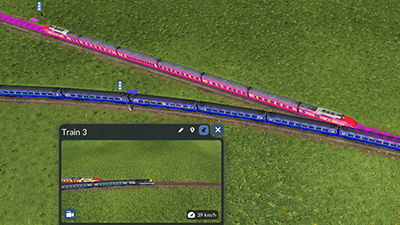
The manual’s correction is to move the signal away from the switch, leaving clearance for the longest train. Measure the train that will actually use this section, including future longer consists. Track on the far side is useful only if the train can wait there without its rear fouling the crossing.
Change the waiting location, then watch both services
- Save the layout and note the longest train using this junction.
- Identify the signal at which the obstructing train waits.
- Choose a waiting position beyond the crossing with full-train clearance, or revise the layout so a train waits before entering the shared conflict.
- Check that the revision still permits both complete routes.
- Resume and follow both trains through the junction, not just the first train released.
For example, an express may wait behind a slow train after crossing a freight branch. Moving the express’s stopping point a little can still fail if its last wagon remains on that branch. The required test is physical clearance of the complete consist, not a fixed number of metres copied from a screenshot.
If the same blockage returns
Inspect where trains stop next, including platform waits and downstream queues. Releasing one trapped train does not prove the recurring waiting position has changed. If a route becomes invalid instead, use the One-way and return-route check. If trains run but repeatedly choose an unwanted track, inspect their actual line routing before adding crossings.
Keep a short observation record: which train waited, where its rear stopped, whether the crossing remained clear and whether the second train completed its movement. This makes the next layout change specific.
Sources and version scope
Urban Games’ official manual supplies the documented controls. Original player discussion supplies the question and community observations. The official comparison documents junction clearance; forum suggestions about exact distances are not treated as universal dimensions. The diagnostic sequence is independently written; no personal gameplay test or guaranteed performance improvement is claimed. Screenshots are the developer’s instructional examples, not the forum author’s save.