Warframe · Riven Splicing · PC 44.1
Riven Splicing: why cycling will not add another trait
On this page
Splicing preserves the number of positive and negative traits, then keeps that layout fixed while the spliced trait remains. Cycling is not a way to turn a two-positive Riven into a three-positive Riven while retaining the splice. Decide which layout you want before spending a Riven Splicer.
Published October 18, 2026 · Update 44.1.0 mechanics checked against Hotfix 44.1.2
Read the layout before the percentage
Count positive traits and negative traits separately. For this decision, a large percentage does not compensate for choosing a layout you do not want to keep. Write the intended layout down before looking at an attractive splice preview.
| Starting layout | What cycling with the splice keeps | What you should not expect |
|---|---|---|
| 2 positive, 0 negative | 2 positive, 0 negative | A third positive appearing while the splice stays |
| 3 positive, 1 negative | 3 positive, 1 negative | The negative disappearing and the trait count changing freely |
These are structural examples, not recommendations that one layout is universally stronger. A negative that interferes with your weapon can make an otherwise appealing roll unsuitable. Judge the whole configuration for its job.
What happens to the two consumed traits?
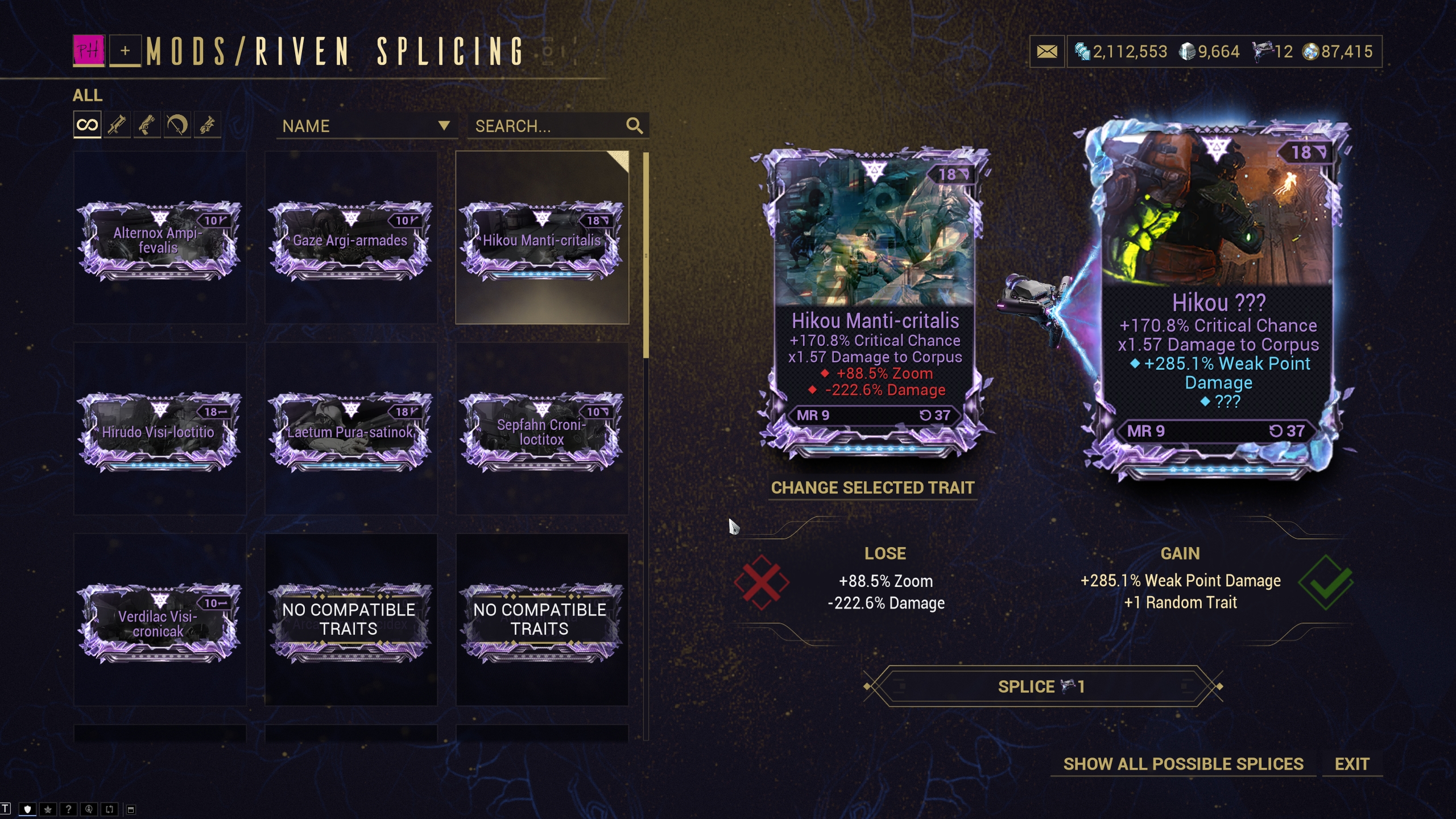
The selected pair is replaced by the chosen spliced trait and a random ordinary trait. The preview does not guarantee that second trait. When a negative is consumed, the replacement remains negative; consuming two positives produces a positive replacement. Inspect which pair is selected rather than assuming that a damaging negative is automatically erased.
- Identify the weapon and the role this Riven must serve in your build.
- Count the current positive and negative traits.
- Read the selected pair in the Lose panel and the known splice in the Gain panel.
- Consider the unknown replacement: can the rest of your setup tolerate another cycle if it is unsuitable?
- Confirm only after accepting both the preserved layout and the resource commitment.
Can I change the layout afterward?
The documented way to undo the splice constraint is to remove the spliced trait: its lock can be removed and it can be cycled off. That means giving up the splice, not keeping it while freely changing the trait counts. Before taking that route, compare the resources already spent with starting from another Riven whose layout better matches your target.
Do not keep cycling solely because you are waiting for a structurally impossible extra trait. First establish whether you want different values within the current layout or a different layout altogether. Those goals require different decisions.
Splicing and ordinary trait locking have different costs
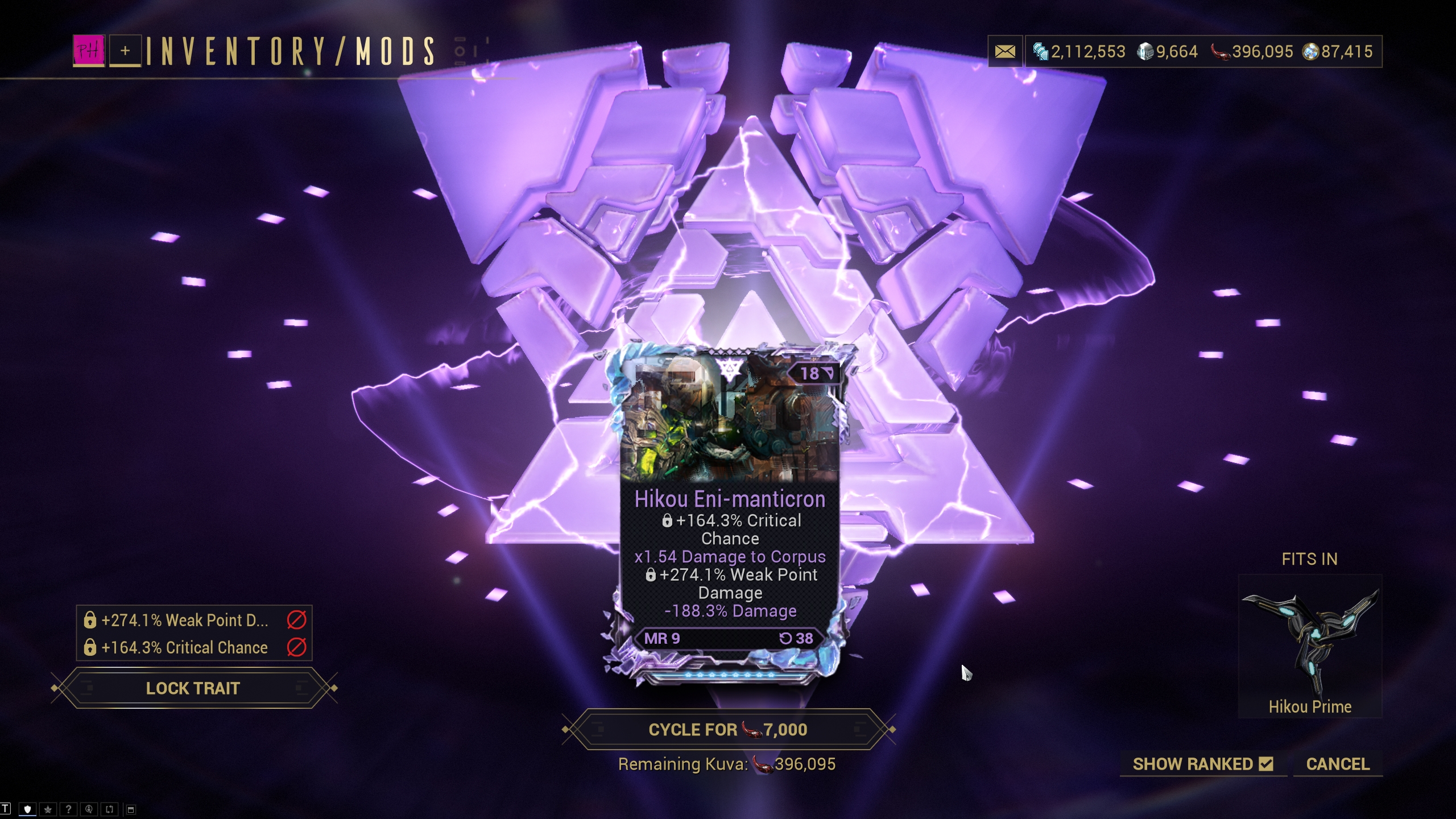
The splice stays fixed without itself doubling the Kuva cycling cost. A separately locked ordinary trait is a different mechanism and can add that cost. The October 15 hotfix also clarifies that locking an ordinary trait locks the positive/negative layout. Read the active locks and displayed cost together; a lock icon alone does not explain which system is responsible.
Early doubled-cost and Weak Point bugs were patched
Hotfix 44.1.1 fixes spliced Rivens incorrectly doubling the cycling cost and Weak Point Damage splices not applying bonus damage. If an early clip shows either problem, do not treat it as the intended current rule. Compare the installed version and active ordinary locks before judging the bill. Official hotfix.
If the actual layout changed unexpectedly
Keep before-and-after images of the Riven, the selected pair and the confirmation result. A different random trait is expected; a changed count of positives and negatives needs a different investigation. Describe that distinction in a bug report and stop spending resources merely to reproduce it. A player report of an unexpected layout is not proof that every splice has the same defect.
Sources and related build help
Mechanics: Update 44.1.0, the developer Riven workshop, and Hotfix 44.1.2. Topic lead: a player discussion of the layout restriction. The comparison table and decision sequence are independently written; no roll odds or trade value are estimated.
For the capacity side of a loadout, see Mod capacity, polarity and Reactors. Return to Warframe guides. Images © Digital Extremes, used for a freely accessible fan guide under the Warframe Content Policy.