Satisfactory 1.0 · Nuclear Power & Waste Recycling
Zero-Waste Nuclear: Ficsonium Fuel Rod Closed-Loop Guide
On this page
- The 1.0 Nuclear Waste Lifecycle: Uranium to Ficsonium
- Dark Matter Residue & Singularity Cell Supply Chains
- Particle Accelerator Ficsonium Synthesis & Power Surges
- Radiation Containment Logistics & Hazmat Suit Buffer
- Zero-Waste Disposal: AWESOME Sink vs Secondary Burning
- Troubleshooting & Nuclear Failsafe FAQ
- Satisfactory tools
Satisfactory 1.0 eliminates the legacy nuclear waste bottleneck by introducing Ficsonium Fuel Rods, enabling 100% zero-waste nuclear power complexes. Burning Uranium Fuel Rods generates Uranium Waste, which is blended into Non-Fissile Uranium, encased into Plutonium Fuel Rods, and burned to produce Plutonium Waste. In Tier 9, Plutonium Waste is fed into a Particle Accelerator alongside Singularity Cells and Dark Matter Residue to craft Ficsonium Fuel Rods. These can be fed into Nuclear Power Plants with zero residual waste, or routed directly into the AWESOME Sink for infinite coupon generation without permanent radioactive dump sites.
Version boundary: Verified for Satisfactory 1.0.0.6+ (Full Release). Production recipes, MAM Alien Technology research trees, fluid dynamics, power scaling formulas, and dedicated server parameters reflect current stable game code.
The 1.0 Nuclear Waste Lifecycle: Uranium to Ficsonium
In all early access versions of Satisfactory, nuclear power imposed a permanent, irreversible penalty: radioactive waste. Uranium Waste could be reprocessed into Plutonium Fuel Rods, but burning Plutonium Fuel Rods created Plutonium Waste, which the game strictly forbade from entering the AWESOME Sink. Players were forced to construct remote lead vaults in the ocean or edge of the map, storing thousands of industrial containers of permanent radioactive poison that contaminated entire biomes.
Satisfactory 1.0 resolves nuclear engineering challenges with Ficsonium Fuel Rods, a Tier 9 Quantum Technology breakthrough that closes the nuclear fuel cycle permanently. The closed-loop recycling process converts every ounce of Uranium Waste into clean, disposable commodities through a multi-stage chemical and particle synthesis chain:
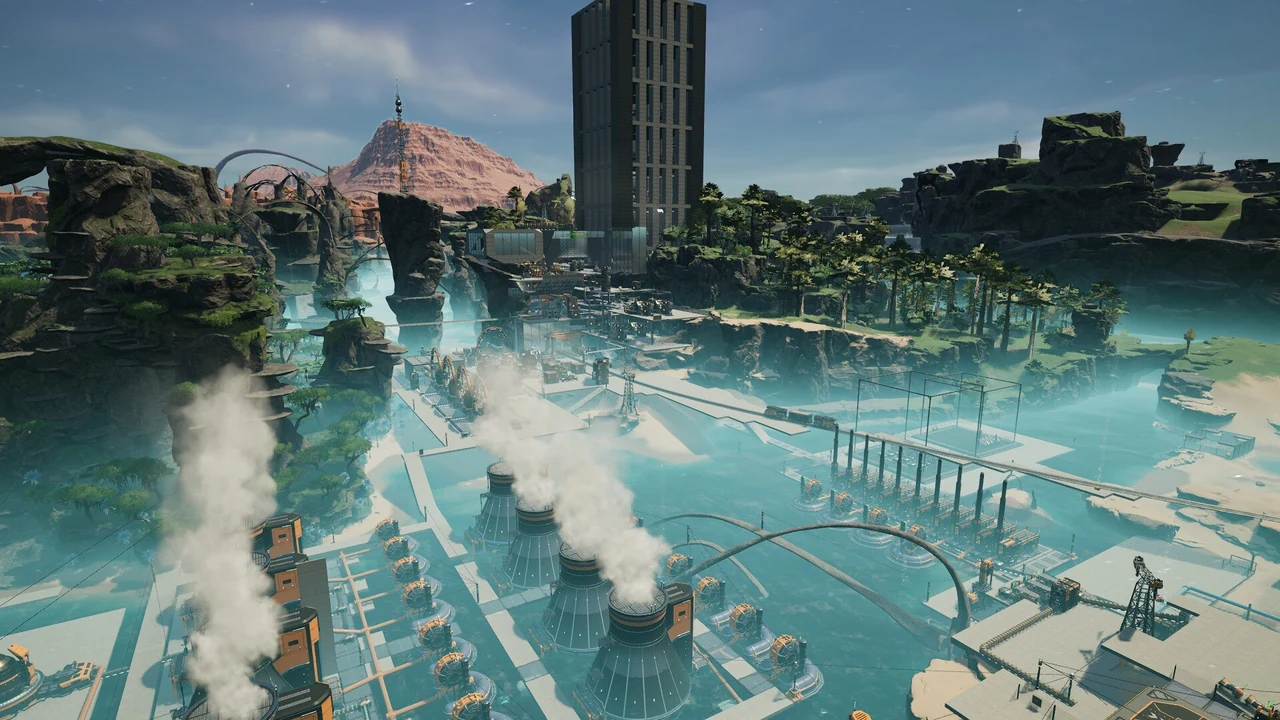
- Stage 1 (Fission Power Generation): Nuclear Power Plants burn Uranium Fuel Rods (each providing 750,000 MJ of energy), producing 10 Uranium Waste per minute per reactor alongside 2,500 MW of power.
- Stage 2 (Non-Fissile Reprocessing): Uranium Waste is routed into Blenders alongside Silica, Nitric Acid, and Sulfuric Acid to synthesize Non-Fissile Uranium, generating recycled Water as a byproduct.
- Stage 3 (Plutonium Encapsulation): Non-Fissile Uranium and Uranium Waste are converted in Particle Accelerators into Plutonium Pellets, which Assemblers encase into Encased Plutonium Cells using Concrete. Manufacturers then assemble Plutonium Fuel Rods using Steel Beams, Electromagnetic Control Rods, and Heat Sinks.
- Stage 4 (Plutonium Fission): Plutonium Fuel Rods are burned in secondary Nuclear Power Plants (each delivering 2,500 MW), producing Plutonium Waste at a rate of 1 unit per minute per reactor.
- Stage 5 (Quantum Ficsonium Synthesis): In a Tier 9 Particle Accelerator, Plutonium Waste is combined with Singularity Cells and Dark Matter Residue to forge Ficsonium Fuel Rods.
- Stage 6 (Zero-Waste Sink Termination): Ficsonium Fuel Rods can be burned cleanly in Nuclear Power Plants with zero resulting waste products, or routed directly into an AWESOME Sink, grinding radioactive materials into millions of FICSIT points with zero environmental fallout.
Dark Matter Residue & Singularity Cell Supply Chains
Synthesizing Ficsonium Fuel Rods inside the Particle Accelerator demands two high-tier quantum precursors: Dark Matter Residue and Singularity Cells. Both components originate in Tier 9 facilities and require dedicated sub-factories to maintain uninterrupted feed rates.
Dark Matter Residue is produced in the Converter building using the default Dark Matter Residue recipe, which consumes 50 Reanimated SAM (Strangely Animated Mineral) and outputs 100 m³/min Dark Matter Residue alongside 50/min Dark Matter Crystals. Because SAM is a finite planetary resource, optimize its extraction using Mk.3 Miners placed on Pure SAM nodes in the Red Jungle or Titan Forest. Pipe the gaseous Dark Matter Residue directly into your Particle Accelerators using Mk.2 Pipelines, remembering that quantum gases exert zero headlift and flow freely uphill.
Singularity Cells represent the containment vessels that stabilize miniature black holes for quantum calculations. Crafting Singularity Cells requires a Manufacturer running the baseline recipe:
- Nuclear Pasta (1.0 / min): Produced in Particle Accelerators from Copper Powder and Pressure Conversion Cubes.
- Dark Matter Crystals (20.0 / min): Byproduct of the Dark Matter Residue synthesis in Converters.
- Iron Plates (100.0 / min): Structural casing material.
- Concrete (200.0 / min): Radiation shielding lining.
- Yield: Outputs exactly 10 Singularity Cells per minute at 100% clock speed, drawing 55 MW of power.
Because crafting 10 Singularity Cells per minute feeds exactly one Particle Accelerator producing 2.5 Ficsonium Fuel Rods per minute, establish a dedicated 1:1 pairing between your Singularity Cell Manufacturer and each Ficsonium Particle Accelerator. Buffer the transfer line with an Industrial Storage Container to absorb micro-stalls during SAM extraction pulses.
| Reprocessing Stage | Facility & Count | Primary Input Materials | Primary Output Product | Power Demand |
|---|---|---|---|---|
| 1. Fission Power | 10 Nuclear Power Plants | 2.0 / min Uranium Fuel Rods, 2,400 m³/min Water | 100 / min Uranium Waste, 25,000 MW Power | Net Producer (+25,000 MW) |
| 2. Non-Fissile Blending | 3 Blenders | 100 / min Uranium Waste, 67 / min Silica, 40 m³/min Nitric Acid | 133.3 / min Non-Fissile Uranium, 26.7 m³/min Water | 225 MW |
| 3. Plutonium Pellets | 2 Particle Accelerators | 100 / min Non-Fissile Uranium, 50 / min Uranium Waste | 60 / min Plutonium Pellets | 1,000–3,000 MW (Cycling) |
| 4. Encased Plutonium | 3 Assemblers | 60 / min Plutonium Pellets, 120 / min Concrete | 30 / min Encased Plutonium Cells | 45 MW |
| 5. Plutonium Rods | 2 Manufacturers | 30 / min Encased Cells, 18 / min Steel Beams, 6 / min Control Rods | 1.0 / min Plutonium Fuel Rods | 110 MW |
| 6. Ficsonium Synthesis | 1 Particle Accelerator | 10 / min Plutonium Waste, 10 / min Singularity Cells, 200 m³/min Dark Matter | 2.5 / min Ficsonium Fuel Rods | 500–1,500 MW (Cycling) |
The primary point of failure in nuclear reprocessing facilities is hydraulic lock inside the Non-Fissile Uranium blending stage. Producing Non-Fissile Uranium requires blending four components inside a Blender: Uranium Waste, Silica, Nitric Acid, and Sulfuric Acid. The default recipe exhibits the following stoichiometry:
- Inputs per Blender: 37.5 Uranium Waste/min + 25.0 Silica/min + 15.0 m³/min Nitric Acid + 15.0 m³/min Sulfuric Acid.
- Outputs per Blender: 50.0 Non-Fissile Uranium/min + 10.0 m³/min Water byproduct.
Because the reaction outputs 10 m³/min of Water, a reprocessing bank of 10 Blenders outputs 100 m³/min of radioactive wastewater. If this water is piped directly into a dead-end or merged blindly with fresh water from Water Extractors, the incoming high-pressure fresh water will block the Blender output ports. Once internal water reservoirs reach 50 m³, the Blenders halt. Uranium Waste then backs up along incoming conveyor belts, triggering nuclear reactor emergency shutdowns and immediate power grid failure.
To establish a closed hydraulic circuit, feed the 100 m³/min of byproduct water directly into the upstream Sulfuric Acid Refineries. Sulfuric Acid synthesis consumes 200 m³/min of Water alongside Sulfur. By utilizing a Variable Priority Junction, configure the plumbing so that the Refineries draw 100% of their water requirement from the Blender byproduct loop first, drawing only the remaining 100 m³/min from fresh Water Extractors. This guarantees the reprocessing Blenders never experience water-logging.
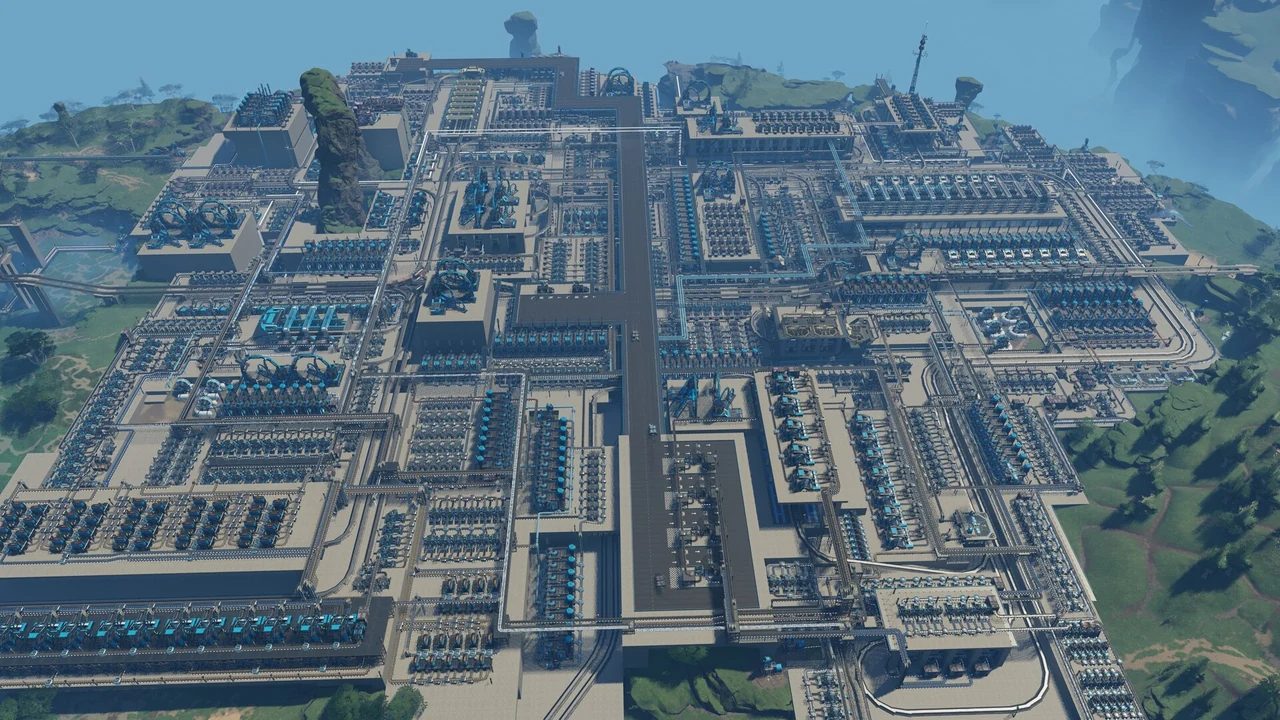
Particle Accelerator Ficsonium Synthesis & Power Surges
Synthesizing Ficsonium Fuel Rods takes place inside the Particle Accelerator, a massive, ring-shaped facility measuring 38 meters by 26 meters. The default 1.0 Ficsonium recipe consumes high-tier quantum resources alongside radioactive Plutonium Waste:
| Ficsonium Synthesis Parameter | Default Ficsonium Recipe | Alternate Ficsonium Triglyceride |
|---|---|---|
| Machine Type | Particle Accelerator (1 machine) | Particle Accelerator (1 machine) |
| Radioactive Input | 10.0 / min Plutonium Waste | 10.0 / min Plutonium Waste |
| Quantum Component Input | 10.0 / min Singularity Cells | 5.0 / min Singularity Cells |
| Secondary Input | 200.0 m³/min Dark Matter Residue | 100.0 m³/min Excited Photonic Matter |
| Tertiary Input | 10.0 / min Electromagnetic Control Rods | 20.0 / min Aluminum Casings |
| Output Product | 2.5 / min Ficsonium Fuel Rods | 2.5 / min Ficsonium Fuel Rods |
| Power Draw Range | 500 MW (idle) to 1,500 MW (peak cycle) | 750 MW (idle) to 2,000 MW (peak cycle) |
Unlike standard production facilities that draw constant wattage, the Particle Accelerator operates on a sinusoidal power curve. Over its 24-second production cycle, power consumption begins at a baseline of 500 MW, ramps aggressively upward to a peak of 1,500 MW during particle beam compression, and drops back to 500 MW upon item completion. Across a bank of 4 Particle Accelerators producing 10 Ficsonium Fuel Rods per minute, the power draw surges between 2,000 MW and 6,000 MW every few seconds.
To insulate your main power grid from these violent fluctuations, construct an isolated sub-station consisting of 30 Power Storage units (delivering 3,000 MWh of instantaneous energy reserves) connected directly between the nuclear busbar and the Particle Accelerator wing. The battery bank absorbs the 1,500 MW compression spikes, ensuring that surrounding factories never experience voltage dips or breaker trips.

Radiation Containment Logistics & Hazmat Suit Buffer
Nuclear engineering in Satisfactory requires strict personal safety protocols. Radioactive items—including Uranium Ore, Uranium Waste, Non-Fissile Uranium, Plutonium Pellets, and Plutonium Waste—emit an invisible radiation sphere whose radius and intensity scale with item count and radioactivity tier. Plutonium Waste emits the highest radiation dosage in the game: a single stack of 500 Plutonium Waste inside a storage container irradiates an area 65 meters in all directions, penetrating concrete walls, glass, and terrain.
Operating inside nuclear facilities requires equipping a Hazmat Suit in your pioneer body slot. The Hazmat Suit negates 100% of incoming radiation damage by consuming Iodine-infused Filters from your inventory. The consumption rate scales with radiation intensity:
- Low Radiation Zone (Border of Uranium Ore belt): 1 filter consumed every 48.0 seconds.
- Medium Radiation Zone (Refinery Blending Hall): 1 filter consumed every 24.0 seconds.
- High Radiation Zone (Plutonium Waste Manifold): 1 filter consumed every 12.0 seconds.
Running out of filters inside a high-intensity Plutonium zone results in pioneer death within 3.5 seconds. Establish an automated Manufacturer line producing Iodine-infused Filters (consuming Quickwire, Rubber, and Gas Filters) and snap a Dimensional Depot Uploader to its output container. With Depot Capacity IV unlocked, your cloud inventory maintains 250 Iodine Filters at all times, automatically replenishing your backpack as you navigate irradiated facilities.
Additionally, isolate all radioactive conveyor belts. Construct elevated logistics tunnels enclosed in Foundation Walls at least 20 meters above player walking paths. Never route radioactive belts through central factory hubs, train stations, or hyper tube transit corridors.
Zero-Waste Disposal: AWESOME Sink vs Secondary Burning
Once Ficsonium Fuel Rods emerge from the Particle Accelerator, pioneers face a strategic operational decision: burn the rods in Nuclear Power Plants for massive energy, or grind them directly inside an AWESOME Sink.
Compare the tradeoffs of both disposal pathways:
| Operational Metric | Pathway A: AWESOME Sink Disposal | Pathway B: Ficsonium Nuclear Fission |
|---|---|---|
| Energy Generation | 0 MW (Pure disposal) | 2,500 MW per Nuclear Power Plant |
| Residual Waste Product | Zero Waste (100% Clean) | Zero Waste (100% Clean in 1.0) |
| Water / Cooling Demands | Zero Water required | 240 m³/min Water per Nuclear Plant |
| FICSIT Coupon Value | 142,520 Points per Rod | 0 Points (Consumed as fuel) |
| Failure Risk | 0% (Sink never clogs or locks) | Low (Requires continuous water cooling) |
Routing Ficsonium Fuel Rods directly into an AWESOME Sink provides absolute, fail-safe stability. The AWESOME Sink never jams, never demands water, and operates with zero maintenance. Sinking 10 Ficsonium Fuel Rods per minute yields 1,425,200 points per minute, generating high-tier FICSIT coupons every few minutes while guaranteeing that your nuclear power plant never backs up with radioactive materials. If you choose to burn Ficsonium Fuel Rods for power, ensure your Water Extractors are powered by an independent, un-trippable geothermal or fuel generator grid to avoid cooling starvation.
Troubleshooting & Nuclear Failsafe FAQ
How can I safely clear a water-locked Non-Fissile Uranium blender line without suffering fatal radiation poisoning?
Attempting to dismantle irradiated pipes manually exposes you to concentrated radiation. To clear the line safely, interact with the connected pipeline segment by pressing E while standing at maximum interaction distance (at least 6 meters away). Click the Flush Entire Network button in the pipe UI to instantly dump all trapped water into the void. Then, check your byproduct return pipe and install an elevated loop with a Valve pointing toward the Sulfuric Acid refinery, ensuring the byproduct water flows downward with gravity assistance.
What happens if the AWESOME Sink loses power while Ficsonium Fuel Rods are moving along the belt?
If the AWESOME Sink loses power, its internal grinding intake halts immediately. Radioactive Ficsonium Fuel Rods will begin backing up along the incoming conveyor belt. Once the belt fills to capacity, the Particle Accelerators will pause production, which subsequently causes Plutonium Waste and Uranium Waste to back up across your entire nuclear complex. To prevent this, connect your AWESOME Sink directly to a priority power circuit backed by Power Storage batteries, or place an automated Smart Splitter before the sink routing overflow into an emergency lead-lined storage container.
Why did my Hazmat Suit fail to protect me even though I had Iodine Filters in my inventory?
This failure occurs when pioneers open their inventory and click the Sort button while standing in an active radiation zone. In Unreal Engine 5, sorting the inventory temporarily desynchronizes equipped armor item checks for a split-second frame window. During this frame, the Hazmat Suit can un-equip internally, exposing the player to raw radiation damage. Avoid sorting inventory while standing within 20 meters of Plutonium Waste or Particle Accelerators; step into a shielded, clean corridor before reorganizing bags.
How do I transport radioactive nuclear waste on automated freight trains without contaminating passenger stations?
Freight Cars carrying radioactive items emit radiation outward in a 25-meter sphere around each car. To prevent contaminating your main transport hubs, construct a dedicated Nuclear Freight Bypass Line that avoids central factory stations entirely. Use dedicated Freight Platforms painted with yellow hazard stripes, and elevate train tracks at least 30 meters above ground level where player characters walk. Never load Uranium Waste onto multi-purpose trains that share stops with passenger transport hyper tubes.
How can I recover a player death crate dropped at the bottom of an active Plutonium Waste containment pit?
If you die inside a maximum-intensity radiation pit, your pioneer respawns at the HUB with an empty inventory—meaning you possess zero Hazmat protection. Rushing back naked will kill you within 4 seconds. Before attempting recovery, craft a new Hazmat Suit and equip at least 20 Iodine-infused Filters from your Dimensional Depot. Build a high-speed Hyper Tube directly to the perimeter of the pit, equip a Blade Runners leg attachment for increased sprint speed, and use the Object Scanner to pinpoint your death crate. Grab the crate contents with E and immediately grapple or jetpack vertically out of the containment chamber.