Dressmaker · Making money · Off-rack sales
How to make money in Dressmaker by selling off-rack dresses
On this page
Once off-rack designing is available in your game, make a dress intended for sale and use the photo scene’s “Sell as off-rack” action. Start with materials you can afford, compare the actual proceeds with what you spent, and only then repeat or increase the investment.
This is a repeatable sale workflow, not a guaranteed fastest-gold exploit. A customer commission and an off-rack sale are different actions.
Official Build 443 sale label and original player reports reviewed October 17, 2026 · Not gameplay-tested · No verified universal sale-price formula or gold-per-minute claim.
Use the correct route: sale, not customer hand-in
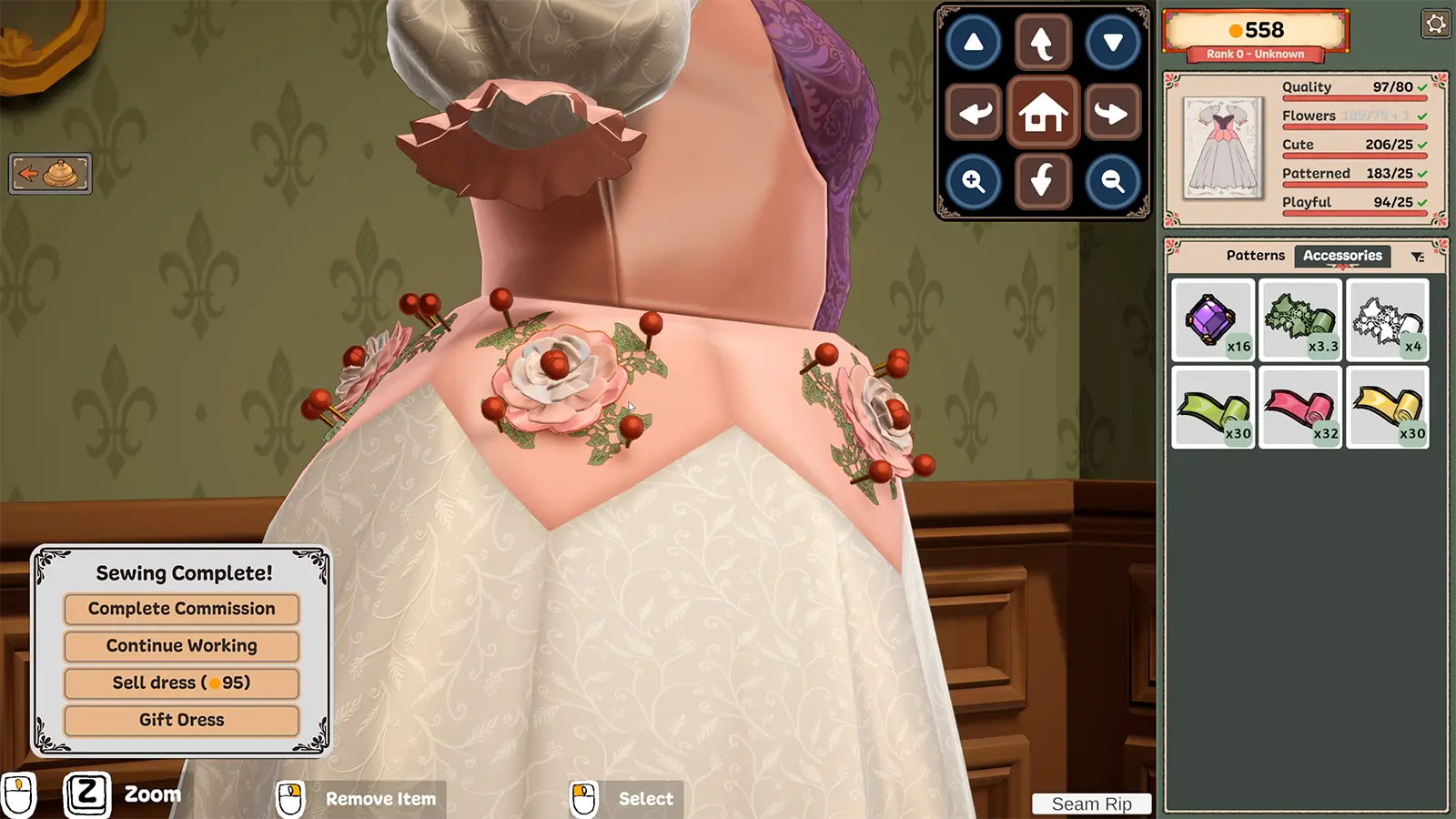
The developer’s Build 443 notes explicitly changed the sale button label to “Sell as off-rack” to reduce confusion. Read that action before finishing: selling your own design is not the same as delivering a customer’s requested dress.
If you are trying to progress a commission, verify that commission’s requirements and hand-in action instead. If you are trying to build funds through a sale, use a design intended for that sale. Do not spend resources on a customer-specific design and then accidentally sell it as stock.
A cautious first money-making cycle
- Check that off-rack work is available. This guide does not invent an exact unlock chapter. If your current game has not opened the option, continue the available progression rather than looking for a nonexistent button.
- Reserve enough cash for unfinished requests. Decide how much you can spend on this sale attempt without blocking a commission. The reserve is your budget choice, not a hidden game rule.
- Prepare a simple dress. Choose components and materials you can actually afford. Follow the normal design, cut and sew sequence; this guide does not require a particular named pattern.
- Finish the garment and inspect the sale action. Read the displayed values and confirm you are choosing the off-rack sale rather than a gift or commission completion.
- Record the proceeds and costs. Use the game’s observed values, not a formula copied from an old post. Keep purchases, materials consumed and existing stock separate.
- Repeat the small cycle before scaling. If you increase accessories or fabric spending, treat it as a new comparison. More expensive decoration is not proof of a better return for your save.
How to tell whether you actually made money
There are two useful accounting questions. They answer different things, so do not mix them:
- Cash movement for this attempt: cash after sale − cash before preparing the dress, excluding unrelated transactions. This shows the change in the wallet during that cycle.
- Material-based margin: sale proceeds − the recorded cost of materials actually consumed. This includes stock you already owned if you have a reliable cost record.
For an illustrative sale of 900 gold using materials recorded at 600 gold, the material-based margin is 900 − 600 = 300 gold. These are hypothetical accounting inputs, not a tested Dressmaker payout. If the materials came from an older purchase, the wallet change during the sale alone would not measure their original cost.
Buying extra stock that remains unused can also make wallet movement look worse than the cost of the one dress. Conversely, treating old inventory as free can make the sale look more profitable than a repeatable purchase-and-sell cycle. Keep both records if you want to compare designs fairly.
What about stacking expensive accessories?
The original Steam money guide by tuxedoClowns describes accessory-heavy off-rack sales. Other players discuss variants in its comments. That establishes a player-reported strategy to investigate, not a guarantee that every accessory or quality state yields the same margin today.
If you try this route, first use a small amount you can afford, record the accessories actually placed, complete the sale and check the result. Increasing investment before confirming the return ties up more money and adds placement time. Avoid an auto-clicker or a giant pile of items merely because a screenshot elsewhere shows one.
The original author presents a tentative formula; a later commenter proposes a different one. We have not independently established either as the game’s complete formula, so neither is used here to promise a payout. The Chinese money article was useful for locating that original report, but translating its formula would not make it verified.
When the sale does not solve your cash problem
You chose the wrong final action: distinguish stock sale, gift and commission delivery. See off-rack versus customer commissions.
You spent most of the wallet buying inventory: inspect what was consumed and what remains. Do not charge the entire stock purchase to one dress when comparing material use, but do account for the cash you temporarily tied up.
The design took too long: profit per dress and profit per minute are separate comparisons. Record actual elapsed time before describing one route as faster.
You need to place repeated decorations: check documented placement and duplication controls and accessory adjustments. These help with interaction; they do not establish a price bonus.
Sources and limits
Developer October Patch Notes — Build 443 verify the sale-action label. The original Steam report above supplies the accessory-sale lead, while the Chinese topic page was a research starting point. No player screenshot or paragraph is reproduced. This workflow has not been tested on our own save, and no exact current unlock point, guaranteed profit multiplier or fastest route is claimed.
Planning spending and decoration achievements → · All Dressmaker guides →